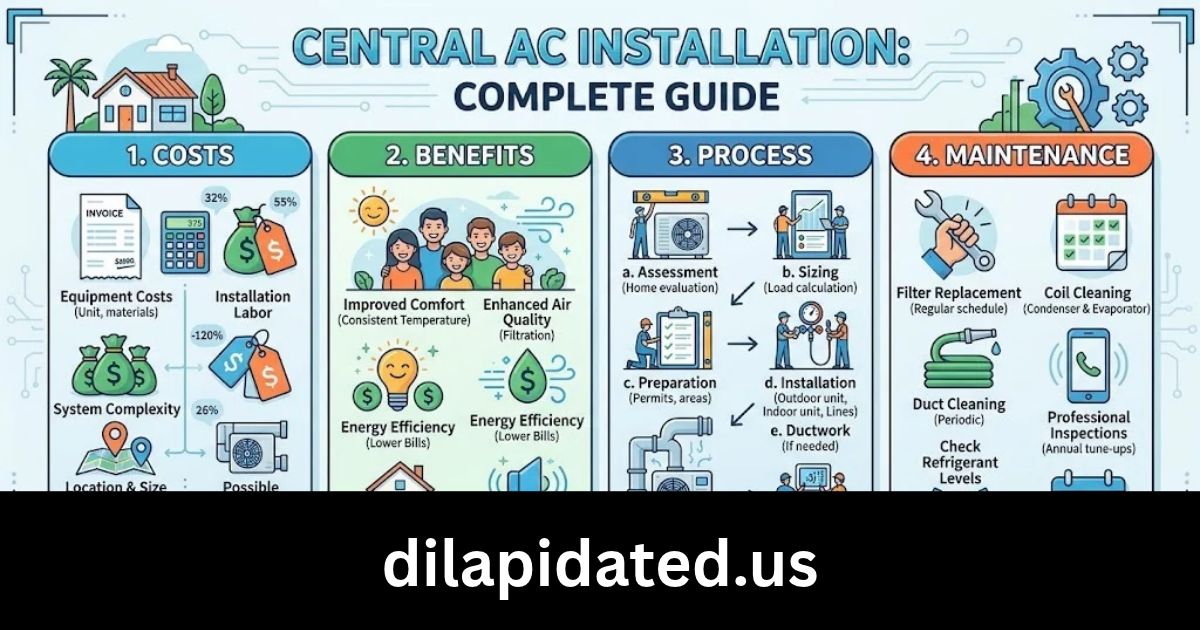
Central AC Installation: A Complete Guide to Costs, Benefits, Process, and Maintenance
Table of Contents
Central AC installation is an effective way to maintain comfortable indoor temperatures throughout a home. Unlike window air conditioners or portable cooling units, a central air conditioning system distributes cooled air through a network of ducts, helping maintain consistent temperatures in multiple rooms. Whether you are building a new house or upgrading an existing cooling system, understanding central AC installation can help you choose the right equipment, plan your budget, and avoid common installation problems.
From selecting the correct system size to understanding central ac installation costs and ongoing maintenance, this guide explains everything homeowners should know before installing central air conditioning.
What Is Central AC Installation?
Central AC installation is the process of setting up a complete cooling system that removes heat from indoor air and transfers it outside. The system typically includes an outdoor condenser unit, an indoor evaporator coil, a blower, a thermostat, and ductwork that distributes cooled air throughout the building.
Central air conditioning is commonly used in larger homes, multi-room properties, and buildings where several rooms need cooling at the same time. When properly designed and installed, it can provide comfortable temperatures, convenient controls, and efficient cooling.
A successful installation depends on choosing suitable equipment, calculating the property’s cooling requirements, and ensuring that all components work together correctly.
Benefits of Central AC Installation
1. Consistent Cooling Throughout the Home
One of the biggest advantages of central AC installation is the ability to cool multiple rooms using a single integrated system. Instead of operating separate air conditioners in different spaces, homeowners can distribute conditioned air through strategically placed vents.
Properly designed ductwork helps maintain more consistent temperatures across bedrooms, living rooms, hallways, and other areas.
2. Improved Indoor Comfort
Central air conditioning helps control indoor temperatures during hot weather. Many systems also remove moisture from the air as part of the cooling process, which can improve comfort in humid conditions.
However, humidity control depends on correct system sizing, airflow, and operating settings. An oversized system may cool the home too quickly without removing enough moisture.
3. Convenient Temperature Control
Most central AC systems use a wall-mounted thermostat that allows homeowners to adjust the desired indoor temperature. Some modern systems offer programmable schedules, smart thermostat compatibility, and remote control through mobile applications.
These features make it easier to maintain comfortable temperatures while reducing unnecessary cooling when the house is empty.
4. Reduced Indoor Noise
Because the compressor and condenser are generally installed outdoors, central air conditioning can be quieter inside than many window-mounted units.
The indoor system still produces some operating noise, and poorly installed ductwork or an improperly adjusted blower can create unwanted sounds. Professional central ac installation helps minimize these issues.
5. Potential Energy Savings
A properly selected central AC system may use less electricity than several inefficient cooling units operating simultaneously. Actual savings depend on equipment efficiency, home insulation, climate, thermostat settings, duct condition, and electricity prices.
Energy-efficient equipment and sealed, insulated ducts can help reduce cooling expenses over time.
Types of Central Air Conditioning Systems
Before scheduling central AC installation, homeowners should understand the main system options.
Split-System Central AC
A split system has an outdoor condenser and compressor connected to an indoor evaporator coil and air handler or furnace blower. Refrigerant lines carry heat between the indoor and outdoor components.
This is a common choice for homes with existing ductwork. It is available in different capacities and efficiency levels to suit various property sizes.
Packaged Air Conditioning System
A packaged system houses the main cooling components in one outdoor cabinet. Depending on the design, it may be installed beside the building or on a suitable rooftop.
Packaged systems can be useful when indoor equipment space is limited, although central ac installation requirements depend on the building layout and local conditions.
Heat Pump System
A heat pump can provide both cooling and heating by reversing the direction of heat transfer. It may be a practical option for homeowners who want one system for year-round temperature control.
Its suitability depends on the local climate, electricity costs, heating requirements, and available equipment.
How to Choose the Right Central AC Size
Selecting the correct system size is one of the most important parts of central AC installation. A unit that is too small may struggle to cool the home during extreme heat, while an oversized unit may cycle on and off frequently, reducing comfort and potentially wasting energy.
Understand Cooling Capacity
Central AC capacity is commonly measured in British thermal units per hour (BTU/h) or tons of refrigeration. One ton represents 12,000 BTU/h of cooling capacity.
Although floor area can provide an initial estimate, it should not be the only factor used to select equipment.
Consider the Home’s Cooling Requirements
A qualified HVAC professional should evaluate several factors, including:
- Total floor area and ceiling height.
- Local climate and outdoor temperatures.
- Number and size of windows.
- Sun exposure and building orientation.
- Insulation levels and air leakage.
- Number of occupants and heat-producing appliances.
- Existing ductwork and airflow restrictions.
In the United States, a detailed residential load calculation is often performed using Manual J or an equivalent method. Other regions may use different standards or calculation procedures.
The goal is to select equipment that matches the building’s actual cooling load rather than relying on a simple square-footage rule.
Central AC Installation Process
Professional central ac installation involves several stages. The exact procedure varies depending on the property, equipment type, and whether the home already has ductwork.
Step 1: Home Inspection and Assessment
The installer evaluates the building’s layout, existing cooling equipment, electrical supply, ductwork, and available space for indoor and outdoor components.
This inspection helps identify potential challenges before work begins and provides the information needed to recommend an appropriate system.
Step 2: Equipment Selection
After assessing the home’s cooling load, the contractor recommends a system with suitable capacity and efficiency.
Homeowners should compare equipment specifications, warranty coverage, expected operating costs, noise ratings, and compatibility with existing components. The lowest-priced unit is not necessarily the most economical choice over its lifetime.
Step 3: Ductwork Installation or Inspection
Ductwork carries cooled air to different rooms and returns indoor air to the system for conditioning.
For a new installation, ducts must be designed and positioned to provide suitable airflow. If ducts already exist, the installer should inspect them for leaks, damage, poor insulation, and restrictions.
Leaky or incorrectly sized ducts can reduce performance even when the air conditioner itself is efficient.
Step 4: Indoor and Outdoor Unit Placement
The indoor evaporator coil and air-handling equipment are installed in an appropriate location with sufficient access for servicing.
The outdoor condenser should have adequate clearance for airflow and maintenance. Its placement should also consider drainage, noise, weather exposure, and the manufacturer’s requirements.
Both units must be installed on suitable supports and protected from conditions that could damage the equipment.
Step 5: Refrigerant Lines and Electrical Connections
The installer connects the indoor and outdoor components using correctly sized refrigerant piping and appropriate electrical wiring.
Refrigerant lines must be properly installed, insulated where required, and tested for leaks. Electrical connections, circuit protection, grounding, and disconnects must comply with applicable electrical codes.
Refrigerant handling should be performed by appropriately qualified technicians.
Step 6: Thermostat Installation
The thermostat is installed in a location that provides a representative reading of indoor temperature. It should generally be kept away from direct sunlight, strong drafts, and nearby heat-producing appliances.
The installer connects and configures the thermostat, verifies system communication, and explains its operating settings.
Step 7: System Testing and Commissioning
Before the central ac installation is considered complete, the contractor should verify that the system operates correctly.
Testing may include checking refrigerant charge using the manufacturer’s specified procedure, measuring airflow, inspecting electrical performance, testing condensate drainage, and confirming that the thermostat controls the system properly.
Homeowners should request an explanation of the controls, filter replacement schedule, maintenance requirements, and warranty documentation.
How Much Does Central AC Installation Cost?
The cost of central AC installation varies considerably depending on the property, equipment, labor rates, and amount of additional work required.
The main cost factors include:
- Equipment price: Larger-capacity and higher-efficiency systems generally cost more.
- Labor: Installation complexity and local contractor rates affect the total.
- Ductwork: New ducts or extensive repairs can add significantly to the project.
- Electrical upgrades: Some homes need new wiring, circuit protection, or other electrical work.
- Thermostat and controls: Smart thermostats and zoning equipment may increase the budget.
- Permits and inspections: Requirements vary by location.
- Removal of old equipment: Existing systems may require safe disconnection and disposal.
A straightforward replacement using compatible existing ductwork is often less expensive than installing central AC in a house that has never had ducts.
For an accurate estimate, request a written quotation that separates equipment, labor, ductwork, electrical work, permits, and additional charges. If possible, compare quotations from multiple qualified contractors.
Is Central AC Installation Worth It?
Central AC installation can be worthwhile for homeowners who need whole-house cooling and want convenient temperature control across several rooms.
It may be especially attractive during new construction, major renovations, or replacement of an aging central cooling system. However, installing ductwork in an existing home can be expensive or impractical when there is insufficient space.
In homes without suitable ducts, ductless mini-split systems may be an alternative worth comparing. The best option depends on the property’s design, cooling requirements, budget, and long-term plans.
Consider both the initial installation cost and ongoing electricity, maintenance, and repair expenses before making a decision.
Common Central AC Installation Mistakes to Avoid
Avoiding common mistakes can improve comfort, reliability, and energy performance.
Choosing the wrong system size: Equipment should be selected through a proper cooling-load calculation.
Ignoring duct leaks: Damaged or poorly sealed ducts can waste cooled air and reduce airflow.
Installing the outdoor unit in a restricted space: Inadequate clearance can interfere with heat removal and servicing.
Overlooking drainage: Poor condensate drainage can lead to water leaks and moisture damage.
Skipping commissioning: A system that has not been properly tested may have airflow, refrigerant, or electrical problems.
Choosing a contractor based only on price: Experience, licensing where required, insurance, references, and warranty support also matter.
Neglecting future maintenance: Filters, coils, drains, and other components need periodic inspection and care.
Central AC Maintenance Tips After Installation
Regular maintenance helps keep a central air conditioning system operating efficiently and reduces the risk of unexpected breakdowns.
Replace or Clean Air Filters
Check the air filter according to the manufacturer’s instructions. Many residential systems need filter attention every one to three months, but the correct interval depends on the filter type, usage, pets, dust, and indoor conditions.
A clogged filter restricts airflow and can affect cooling performance.
Keep the Outdoor Unit Clear
Remove leaves, grass, and other debris from around the condenser while maintaining the manufacturer’s required clearance. Switch off power before performing any permitted exterior cleaning, and never open electrical compartments or damage the coil fins.
Inspect Condensate Drainage
The condensate drain removes moisture collected during cooling. A blocked drain may cause water leakage or activate a safety switch.
Arrange professional service if you notice persistent water around the indoor unit or signs of drainage problems.
Schedule Professional Inspections
A qualified technician can inspect electrical components, refrigerant-system performance, coils, airflow, and other important parts. The recommended service frequency depends on the equipment, usage, climate, and manufacturer guidance.
Use Sensible Thermostat Settings
Choose a comfortable temperature and avoid unnecessarily extreme settings. Programmable schedules can reduce cooling when the house is empty, while fans may help distribute air when used appropriately.
Frequently Asked Questions About Central AC Installation
1. How long does central AC installation take?
A straightforward replacement may take one day, while a new central ac installation involving extensive ductwork or electrical upgrades may require several days or longer. The contractor can provide a more accurate timeline after inspecting the property.
2. Can central AC be installed in an existing home?
Yes. Central AC can often be installed in an existing house, provided there is a practical way to install the equipment, refrigerant lines, and ductwork. If adding ducts is difficult, a ductless system may be more suitable.
3. How do I know what size central AC I need?
The correct size depends on the home’s cooling load, not just its floor area. A professional load calculation considers insulation, windows, ceiling height, climate, sun exposure, and other factors.
4. Does central AC increase electricity bills?
Yes, central air conditioning uses electricity, and the amount depends on system efficiency, usage, climate, and home insulation. Efficient equipment, good duct sealing, and appropriate thermostat settings can help manage operating costs.
5. How long does a central AC system last?
Many residential central air conditioning systems last approximately 15–20 years, although lifespan varies with central ac installation quality, maintenance, operating conditions, and equipment design. Some systems need replacement earlier, while others last longer.
6. Is new ductwork always required?
No. If existing ducts are correctly sized, well sealed, insulated where necessary, and in good condition, they may be reused. A professional inspection can determine whether repairs or replacement are needed.
7. Should I install central AC myself?
Central AC installation is generally best handled by qualified HVAC professionals because it involves electrical work, refrigerant piping, equipment sizing, and system commissioning. Incorrect installation can create safety risks, reduce efficiency, and affect warranty coverage.
8. What should I ask a contractor before installation?
Ask about the cooling-load calculation, equipment specifications, total written cost, installation timeline, ductwork requirements, warranty terms, permits, and commissioning procedures. Also confirm who will handle future servicing and repairs.
Conclusion
Central AC installation can transform indoor comfort by providing consistent cooling, convenient temperature control, and the potential for improved energy efficiency throughout a home. The best results come from selecting the right equipment, calculating the property’s cooling requirements accurately, ensuring that ductwork is properly designed, and hiring a qualified installer.
Before committing to a system, compare equipment options, request detailed quotations, and consider the long-term cost of operation and maintenance. With careful planning and regular servicing, a properly installed central air conditioning system can provide dependable comfort for many years.